Cut for time: Tampax Secrets
Year aired: 2019
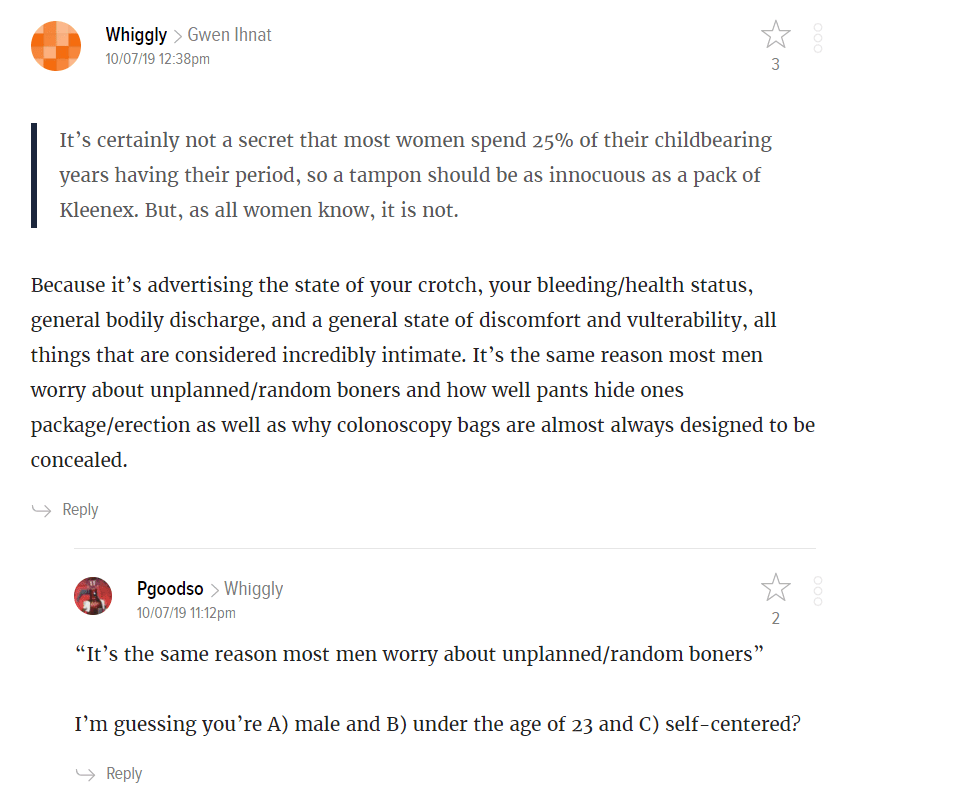
Interestingly enough, this skit was unfortunately cut for time, which this socially sensitive topic/taboo – of periods – which could possibly be a factor as to why it was cut to air, even though it was an absolute masterpiece and I laughed way too much at this, especially the part where they introduce what items are used to disguise the tampons. The Tampax Secrets skit creates a discourse about the anxieties women feel displaying to the public that they are on their period. Evelyn Fox Keller “It may be difficult… to understand the enormous reticence with which anyone, especially a woman, would make public his or her personal impressions and experiences, particularly if they reflect negatively on the community. To do so is not only considered unprofessional, it jeopardizes one’s professional image of disinterest and objectivity. Women, who must work so hard to establish that image, are not likely to take such risks. Furthermore, our membership in this community has inculcated in us the strict habit of minimizing any differences due to our sex” (The Anomaly of a Woman in Physics, Evelyn Fox Keller). This skit is definitely an effective way to promote normalization of the availability and use of menstrual products in public. Bonus: And because of users like Whiggly, this is why tampon shame is still a thing:
Xanax for Gay Weddings
Year aired: 2013
Honestly, being a part of the LGBTQ+ community myself, I thought this commercial was pretty funny. I can see why some people would be offended at this, because it’s somewhat being insensitive towards people that actually suffer from anxiety when going to social events, but the concept of having anxiety of living up to the standard of gay weddings is priceless. It’s even better because if you really think about it, the underlying concept of this fake commercial is to mock homophobic people, which is also priceless! This was aired at a time when same-sex marriage was not as normalized, and it was not legalized across all 50 states, so this was definitely an acceptable notion of normalization by utilizing humor as a medium.
HeroinAM
Year aired: 2016
If you look through the hashtag #HeroinAM on Twitter , and if you look through other social media platforms, you can see that many are divided on the topic of whether heroin was an okay topic to joke about. Especially with the opioid crisis happening in America, people have been dying from prescription opioids and heroin every day. Reported deaths from heroin overdoses nearly quadrupled between 2002 and 2013 – with nearly 30,000 overdose deaths reported in 2014. In 2017 HHS declared a public health emergency and announced a 5-Point Strategy To Combat the Opioid Crisis. This skit was actually less of a joke and more of a call to action, as the topic may be sensitive and offensive to many, but its primary goal was to bring attention to the fact that the Opioid Crisis must be addressed and more discourse must be created in order to bring the epidemic to a close.
PottyPM
Year aired: 2019
This is definitely another belly-laugh-worthy skit, and it’s probably because it’s almost like life is imitating art. PottyPM replicates the cultural anxiety of men not knowing women’s anatomy.
Woman: And how does it [PottyPM] work for women?
Man: What’s that?
Woman: Is that also for women?
Man: Yeah….
Woman: Good, ‘cause we have to go in the middle of the night, too. So how does it work?
Man: You put the tube inside of your—
Woman: Inside?
Man: Isn’t there like a flap so you could like—
Woman: Excuse me?
Man: Is it the— clitoris?
Woman: What?
Man: The clitoris?
On a more serious note though, the fact that men still continue to not be thoroughly educated on the topic of women’s anatomy, is honestly worrisome. In many sex education programs throughout the country, education is separated by sex, where an individual ends up learning the ins and outs of what sexual development and maturity is like in ones own sex assigned at birth, but it is very likely that one does not know exactly what happens in sexual development and maturity looks like for the other sex. In this situation, humor is definitely a productive medium to advance conversations around enhancing education to gender differences in sex education. Normalization of being thoroughly educated of both genders’ development is crucial, as Evelyn Fox Keller states, “An awareness of the political and social realities might have saved me from persisting in a search for affirmation where it could not and would not be given. Such a political consciousness would have been a source of great strength. I hope that the political awareness generated by the women’s movement can and will support young women who today attempt to challenge the dogma, still very much alive, that certain kinds of thought are the prerogative of men” (The Anomaly of a Woman in Physics, Evelyn Fox Keller). Unfortunately, the choice of what happens with women’s bodies have now become a political topic, even though not all cis-gendered men that hold powerful political positions are fully educated on what exactly happens with a woman’s body, but that’s another topic for another blog post!
Once Daily Estro-maxxx
Year aired: 2011
Finally, we have the infamous SNL production of the fake product “Once Daily Estro-maxxx”, a rather controversial and a skit that has been deemed as transphobic which actually demanded SNL to issue an apology to GLAAD, an anti-discrimination non-governmental media monitoring organization, following the airing of it. GLAAD states in their petition that demanded an apology from SNL, “This segment cannot be defended as “just a joke” because there was no “joke” to speak of. The attempted comedy of the skit hinges solely on degrading the lives and experiences of transgender women.” The fake commercial attempted to mock the use of estrogen replacement therapy by utilizing visual comedy, putting clearly straight men in dresses with facial hair, essentially mocking the acceptance and appearances of transitioning transgender individuals. Usually, the goal of a spoof is to make fun of a group that could even be marginalized and their mannerisms, not making fun of who they are and an already sensitive topic in itself. Bernice L. Hausman discusses the struggles that transgender individuals experience as they transition to be more comfortable in their own body with their identity while at the same time having the pressure of pleasing the rest of the world by adhering to socially-constructed gender roles: “Transsexuals’ investments in traditional gender ideologies may serve as a cover for the de- stabilizing multiplicity of sexed positions made available through developments in medical technology… Demanding physical transformation through surgical and hormonal technologies, transsexuals seek admittance into the social technology of gender as its representative subjects” (Demanding Subjectivity: Transsexualism, Medicine, and the Technologies of Gender, Bernice L. Hausman, pp. 302). When we piece all of these factors together, we can definitely say that SNL took a low blow here as the skit most definitely didn’t age well, setting the bar low for comedy and making more room for transphobia.
That’s all, folks! Cheers!
Chelsea Aleong
 Chats with Chelsea